Game Design, Programming and running a one-man games business…

We got a heat pump (at last)

It was inevitable really. I’m a life-long environmentalist who got solar panels 15 years ago, an EV 11 years ago, and a battery a few years ago. I also spent my own money to madly build a 1.23MWP solar farm. Of course I was going to get a heat pump. In fact you may well have assumed I already had one. Why was I not earlier to this?

We live in a very old house. Its funny because where I live, its just considered an ‘old’ house, because there are so many here, but by most people’s standards its ludicrously old, as it was built in 1750. Living in a house like this is kinda awesome, if you like BBC costume dramas, and it certainly has a lot of ‘character’, but there are definite drawbacks. One is that it is quite cold, as the walls are single-thickness, without cavities, and the other is that you need government permission to change anything.

When heat pumps first came out, there was definitely a vibe o ‘well its cool if you have a passivehaus’ and then things migrated to be ‘its great as long as you have underfloor heating and excellent insulation’. This was still no good to us, as our floors are either suspended wood over a cellar, or brick and huge chunks of stone. Underfloor heating would never be a thing here. But then heat pumps got better and better, and we managed to (finally) get double glazing, and it actually looked like getting a heat pump might work for us.

Quotes and Grants

Luckily a neighbour of ours already had one, so we went and gawped at it, and asked questions etc. (They have a newer house). Eventually we decided to go for it, and got quotes. Oh my god the quotes. First we needed to get an ‘Energy performance certificate’ for our house, which basically means pay £100 to some freshly qualified surveyor who walks around your house and fills out a form. Like many govt programs, this was a big waste of time, because although you need the certificate, the govt dropped any limit on how efficient the house had to be before getting a grant for a heat pump. The certificate is thus just a piece of paper that gets stuck in a drawer that was pointless, but we had to do it anyway.

Why did we need it? Well because the UK government, for all its sins gives you £7,500 towards a heat pump, and that certificate process is the only string attached. So well worth it. Why did they drop the efficiency limit? Well someone in govt finally worked out that the only people getting heat pumps installed were retired middle class people who tended to live in old houses. If the efficiency limit was too strict, they wouldn’t bother, and they need ‘early-adopters’ like us to kick-start uptake of heat pumps. Getting the grant was satisfying because I have NEVER got a grant from the govt to do anything (not even the solar farm).

Anyway, grant plus paperwork in place, we got three companies to give us heat pump quotes. One was just totally useless. Another did an exhaustive heat-loss survey, but all of the numbers were blatantly just wrong. We eventually went with a third (which our neighbours used), and they were tons better. Basically they need to come measure your rooms, look at your radiators, do a ton of calculations and decide what size heat pump you need, and if you need to upgrade radiators. We were told we needed a 14KW heat pump, and no urgent radiator upgrades. In the end we doubled the size of two of them anyway, in rooms that were always cold.

We then needed ‘listed building consent’ and ‘planning permission’, and that was an epic world of stupid stupid pedantic pointless government bureaucracy bullshit I won’t bore you with, because unless your house is listed, you wont need it.

The Installation

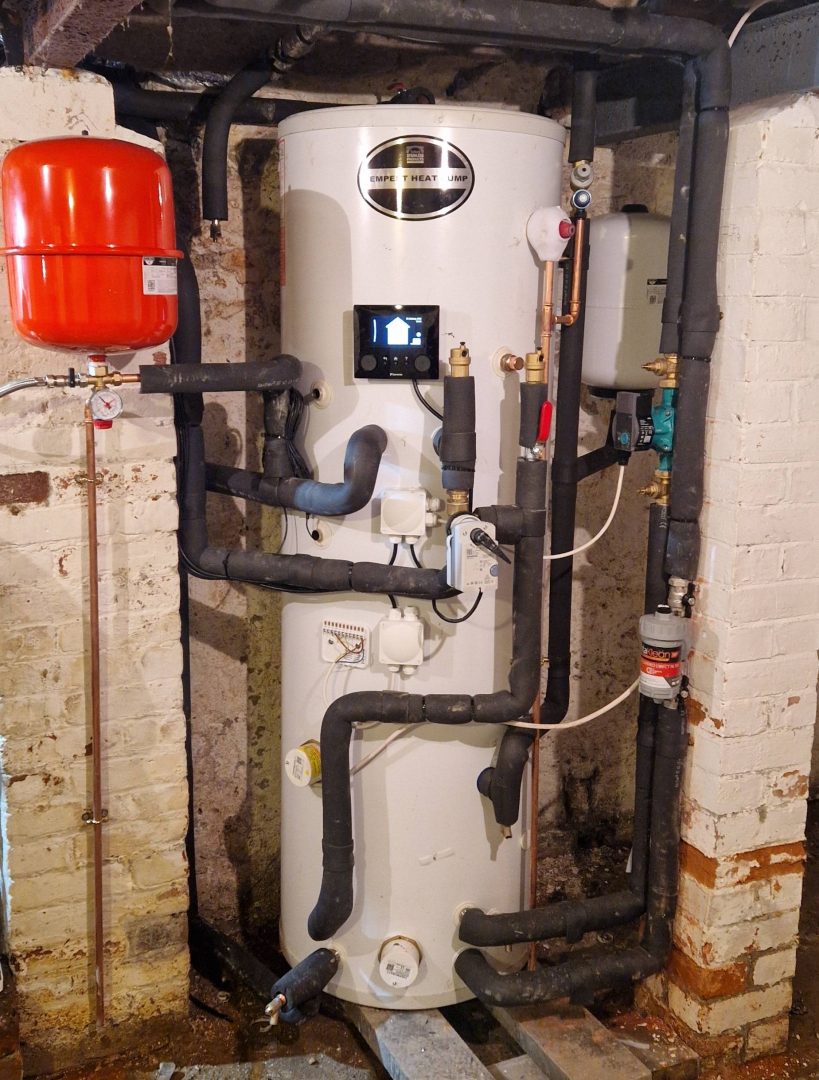
And so it came to pass that people came and installed a heat pump. Yay. Because we had previously had an outside oil combi-boiler, our house had zero hot or cold water tanks. So we needed one of those. And luckily, it went in our cellar, which is where we put stuff like batteries etc. This was awesome as it meant taking up zero room in the house. I was impressed that the installers were not put off by having to install a hot water tank and ton of heating controls down some tiny steps in a cellar, especially as the door to the cellar is actually a secret door that works as a bookcase. Its all very scooby do.

Anyway, after a few days of fuss, we ended up with this!
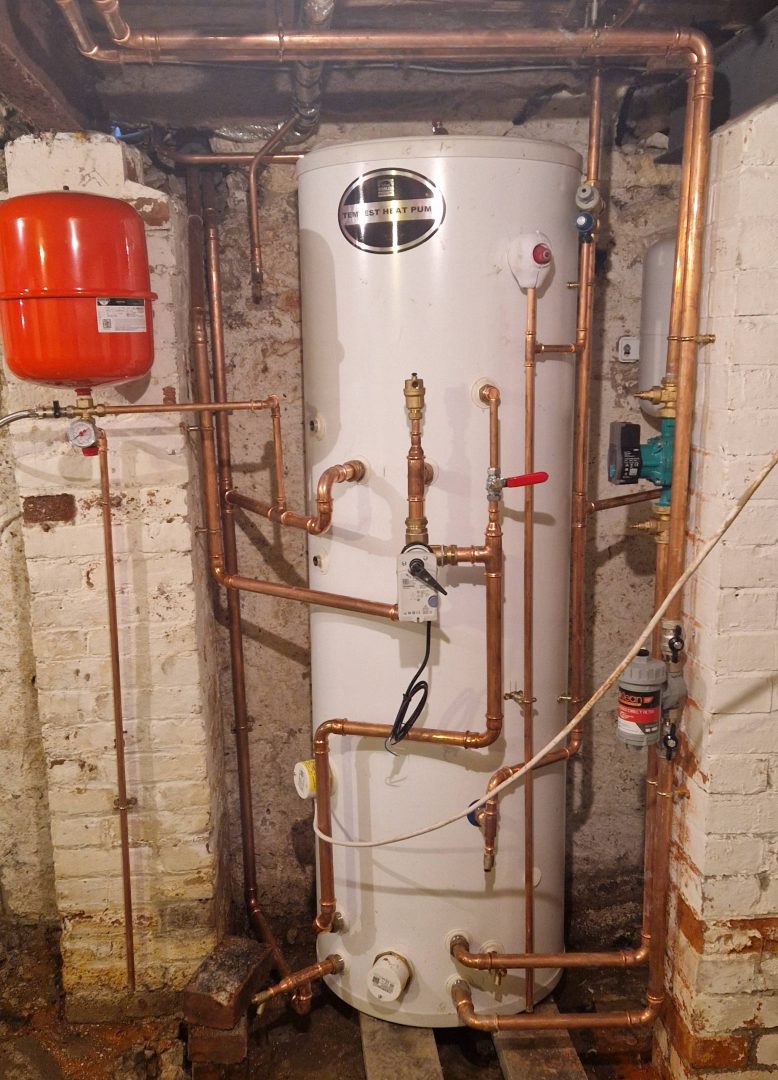
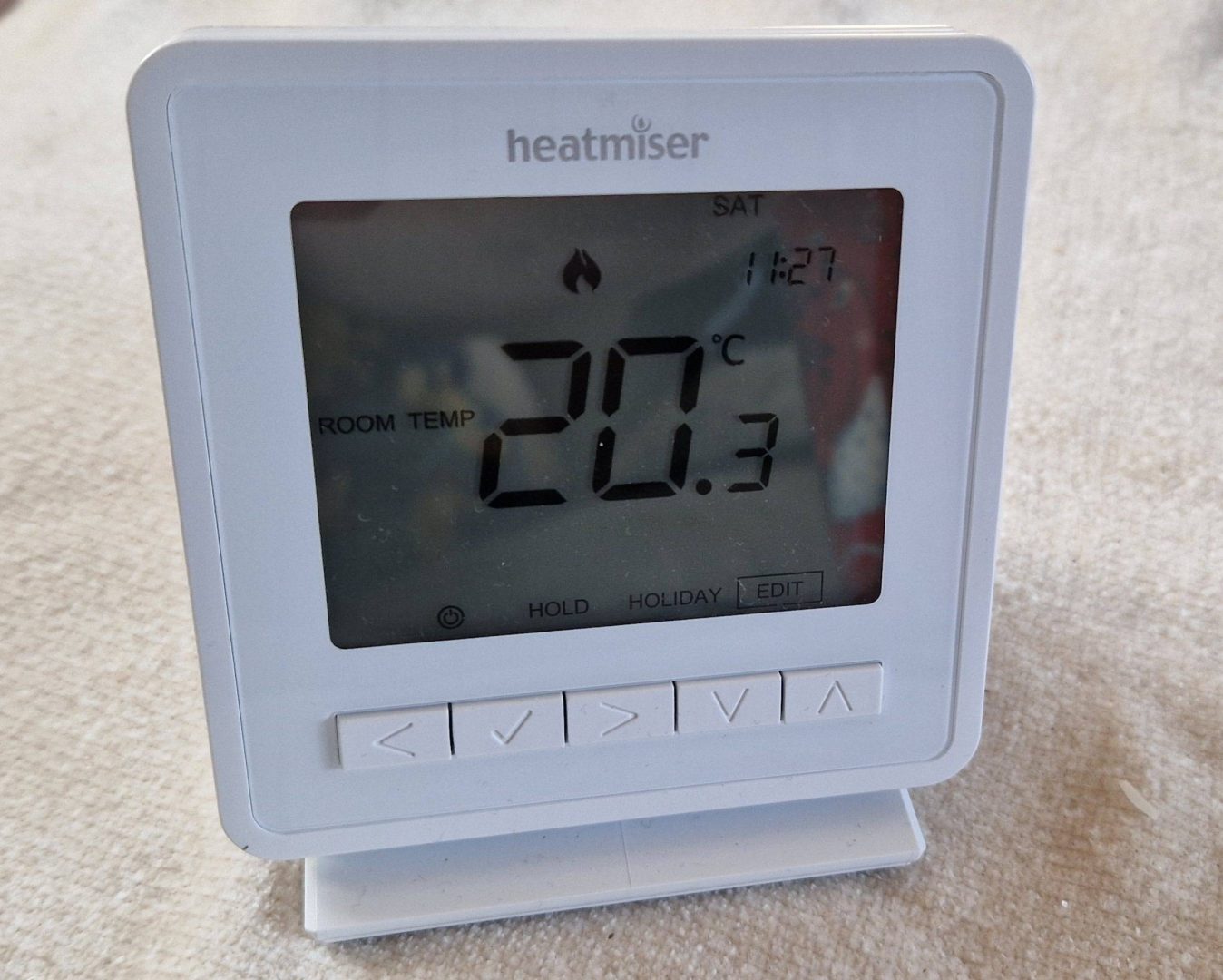
And if you think ‘seriously thats a lot of tubing’ I agree with you. I had it all explained to me, but I zoned out a bit. It looks more complex than it is, and you can basically ignore it all and just use a tiny little remote thermostat gadget to control it all that looks like this:
And of course the actual heat pump got installed (which was way quicker) and the old boiler removed. It went in the exact same place and is here:
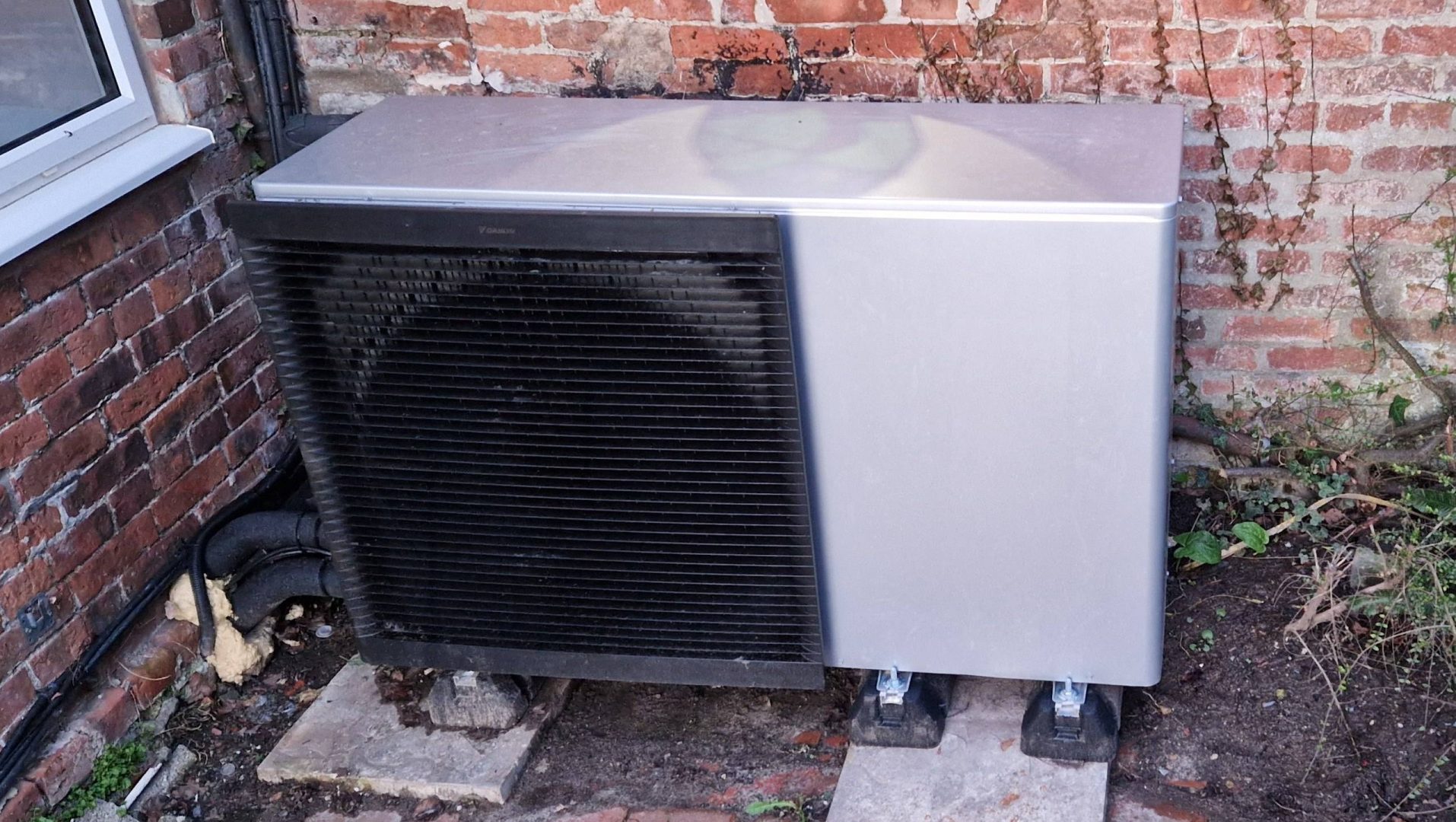
I should point out this is a BIG heat pump for a 1750s 3 bedroom detached house. If you have an average UK terraced house a heat pump would be 5-8kw. Ours is 14kw. Also worth pointing out that although the total cost for our heat pump massively exceeded the £7.5k grant, that would be VERY different for a typical smaller one, especially if you already have a hot water tank and don’t need it installed somewhere awkward.

So the heat pump was installed, and everything was great. The end.

The difficulties and the fix

But no! It was an irritating nightmare of unhappiness for a few weeks. We had major problems. Firstly it seemed like it used a TON of electricity to do NOTHING. It then seemed that it COULD generate hot water (and lots of it), or hot radiators, but never under our control. It was frustrating and disappointing and I was unhappy :(. We argued and complained a bit. We also decided to double the size of one of the two radiators in our living room. This was a good move and made a big difference, BUT what totally transformed everything was the radiator dude spotting that the ‘Hysteresis’ was set wrong. This is a setting that determines how much the heat pump lets temperatures diverge from the thermostat before switching. Heat pumps do NOT like to be constantly going on and off. Insanely ours was set to 20 degrees, when it should have been 8 or even less. So our heat pump would be told to get the radiators to say 50 degrees, do it, then switch off and not care about switching back until they were 40. The same happened with hot water. It also controls how much you can overshoot, so a Hysteresis of 20 means radiators oscillated from 40 to 60.

In practice what this meant is that it all felt RANDOM. Sometimes radiators were super hot, often seemingly cold. Ditto hot water. It felt like the whole system was under someone else’s control. It sucked. We had heat-pump-purchase regret. But actually the minute that setting got changed, everything then worked perfectly, and we are very happy. The house is warmer than ever.

Its worth pointing out we had several conversations with the installer, lots of emails and frustration before eventually it was spotted that this was wrong. We are so glad that we persevered to make sure it was set up correctly, instead of just being grumpy and mumbling that ‘heat pumps suck’ which I think some people do when they have this problem. Check your settings!

The conclusions

So… was it a good idea? Well actually YES. If you read my blog you know I would do it anyway. Its about the environment for me, not money. I HATED buying thousands of litres of oil to heat our house, and wanted to remove my last direct usage of fossil fuels. But actually now its all set up right and we have the right radiators, its pretty good. And our timing was comically good. Not only was our oil tank 99% empty when they took the old boiler away (luck!), but just as we are settling in to our oil-free lifestyle, the Iran war starts and the price of heating oil has more than DOUBLED. Our electricity bill is definitely a lot higher, but then we now have zero oil bill. Plus we had the heat pump fitted in winter, so it was always going to be the most expensive time to assess how much power we now used.

So, my tips for anybody considering it? Firstly I would say shop-around and read reviews. Some installers are good, some not. Same as anything. Ask neighbours who have had one fitted for references. Secondly, take any recommendations about new radiators seriously. We were a bit flippant. We should have got that radiator fitted at the same time. Thirdly, Make sure its set up right. They are COMPLEX and you need it set up right for your lifestyle and your home.

But generally, I am very happy. Out of solar, batteries, EV and heat pump, this was the most disruptive and hardest upgrade. However if you are in the UK don’t delay. That govt £7,500 grant will NOT be around forever. Take advantage of it. Oh and if you are thinking of getting solar or a battery, GET LOTS. We have gone from smugness about our 4.1kwp solar and 19kwh batteries to ‘Balls, I wish we had more…’. A heat pump does push up how much electricity you use, so generating more and storing more off-peak power will be well worth it.

Unexpected Solar-Powered Borehole Update!

I did not expect to be typing this so soon, but pretty soon after we agreed to fund a solar-powered borehole for fresh clean water in Cameroon… I got an update on construction with pictures today! Very welcome as I expected this to take many more months. Here is what I received today:

“Anyway, the situation in Bagham was pretty desperate because it is currently the height of the dry season in that part of the West region and SHUMAS staff reported that there wasn’t a drop of water in the village. Fortunately, the drilling rig was available and was located quite close by so work could start straight away. I am attaching a photo of the drilling rig in place and others of the work which has been started on the construction of the tower for the tank. I am sure that this project will progress quickly”

How cool is that? Here are the pics:

Digging foundations for the water tower
Making the reinforced framework for the tower
Drilling Rig
Making framework for the tower

Its very uplifting for me to see progress on stuff like this! And if you buy any of my games, you are helping me fund stuff like this, which means you are awesome :D. Especially excited to see the eventual solar panels go in etc :D.

A calendar year of solar farm ownership

So yup, I somehow built a solar farm, and it was tricky, but now is the relatively easy bit, where I just have this huge capital asset sat on a hillside somewhere, and hopefully it makes some money? Lets look at what an actual real uninterrupted solar farm ownership year looks like. Which obviously means looking at the annual combined chart from the 10 Solis inverters:

I also have very similar data from the actual overpriced meter that measures the farm output. Thats normally lower (and is sadly the metric I get paid on), because there is some leakage of power in the transmission from inverter to to meter. However there was some data-outages in the inverter reporting during the year (since fixed with a better router), so some inverter data was lost, but caught by the Orsis meter, which is therefore a higher number! Here is that chart:

So in general the chart of output was pretty much as expected, as was the total output. There was a bit of a weird skew towards earlier in the year. March and April were weirdly high, and July and August weirdly low. Normally I would expect a perfect bell curve. BTW if you have home rooftop solar and think this chart looks weirdly smooth, be aware that we have obviously no shading, and the panels cover 4 acres, so any minor fluctuations do tend to cancel each other out. But anyway, lets talk business!

I do not have actual accounts for that period, but a quick rough check shows that the money paid to me in that 12 months by the energy company I sell to (Ovo) totalled about £146,000. That includes selling the REGO certificates, also to Ovo. That sounds quite nice until you deduct all the costs. So for example:

  • Energy import costs (to run the site) £6,000
  • Rent payment to landowner £6,200
  • Internet/Connectivity for meter £800
  • Accountancy for company £1,000
  • Repair costs for storm damage £8,000
  • Other minor costs £100
  • Maintenance (Annual) £9,300

So some quick sums show a whopping annual profit of £114,600. OMG amazeballs.

But hold on a minute… surely I need to depreciate a solar farm that has cost me about £1.6m to build. So over 25 years that becomes an annual depreciation of £64,000. so that leaves me with a profit of £50,600.

I would be very happy with that, but in truthy I need to set aside funds for two other events. One would be the failure of an inverter. They are not cheap, and replacement costs are non trivial, so lets assume this costs me £10k every year. Lets also assume there is some money set aside for some catastrophic event requiring panel replacements, or theft of cables etc, and put that at another £15k a year (minimum). Thats then a profit of £25,600 per year.

Also be aware that the output from the panels will very slowly degrade over time, so the revenue may actually fall, and if wholesale energy prices fell, they could fall further. But lets be optimistic and go with £25k a year in actual profit. That works out at a return on investment of about 1.56% a year. Now to be fair, everything needs to be inflation adjusted, as prices will rise, but so will costs, and therefore that 1.56% is a REAL return, not the same as interest on a bank account. So for example, right now my company bank account pays 4.25% but inflation is 3.5% so the ACTUAL rate of return is only 0.75% which means…

THIS GIVES ME A BETTER RETURN THAN A SAVINGS ACCOUNT

Which is a relief (that its not actually losing money), but still a little less than hoped for, But if you know me, you know I did this for the environment, and to do my bit in the fight against climate change, even if certain maniacs in the US are determined to actually do the opposite and kill us all. This was never a business decision, but a passion-project one. And who knows, energy prices could rise! And in terms of ‘the solar business’ I did a VERY BAD JOB of getting this built. That £1.6m could have been more like £1.3m if I was more aware of what I was doing. I am very sure that big solar farm developers, or just more experienced ones do a better job, have economies of scale, and get better returns.

I regret nothing. I won a solar farm and its awesome. I didn’t do a good job of getting it built, but I made it happen!

A solar farm after 6 months: Maintenance report

So…my site has actually been live for 11 months now, but there has been a bunch of stuff that needed fixing after initial energization, so the six monthly maintenance thing happened a bit later. If you are asking ‘does it really need maintenance every six months?’ the answer seems to be yes. I pushed back on this, as I thought it was overkill, but have been talked around. if I owned 10 solar farms, I’d totally let one have maintenance every year or 18 months to see if it was worth it, but with a single asset I likely shouldn’t risk it.

Anyway, I just got the first report. Its VERY long and detailed. Its a 90MB PDF file, if that helps contextualize it. Here are some highlights:

Firstly, google have updated their data and there is now a proper google maps image! They add little points on the image to tell me where stuff was spotted that might need fixing, or keeping an eye on:

In general the summary of the report is this: “The inspection of the site and inverters, and testing of the DC circuits, found generally positive results, although some minor issues were identified – details in the report.” – Which is very good news because frankly so much stuff stressed me out as it was built I really could do with a few long sustained periods of just simple revenue generation from it. I think I will be at least 68 years old before it breaks even, but as long as it eventually does, I’ll be ok with that. This was not a money making scheme for me.

The report has a huge number of photos, including some cool ones. Here are ones that might be interesting:

Checking for hotspots on some panels with a thermal camera:

Checking the DC cables going from strings to inverters still look ok:

You get before-and-after pictures showing that the fans on the inverters have been cleaned. I visited one hot day when the fans were really going for it. I could hear them from 30 feet away. Each inverter is 80-100kw output, so the fans are working pretty hard sometimes. I’m not sure these really need cleaning twice a year, but we have only had one winter so far. Maybe super stormy and muddy weather will be way worse.

There are pages and pages of testing data like this table, which makes sense if you are an electrician, but from my POV its just nice to have a historic benchmark for this stuff so if anything fails we can look back and see what went on:

You also get thermal pictures of all the isolating boxes for the inverters to check there is nothing scary going on inside them:

They also get taken apart and cleaned. I think that might be a bit overkill too. Its tricky. On the one hand, what do I know? on the other hand people who service stuff always have misaligned incentives with regards to what is ‘essential’. If I had a hundred million pounds, I’d buy my own solar farm installation and maintenance company and then I’d know…

There is a ton of other stuff but I will spare you thirty pages of before-and after pictures of plastic boxes that got cleaned, or the many pictures of slight patches of rust on the edges of some supporting frame struts. I guess its good evidence that it was done thoroughly, with a lot of time spent looking for problems. Rather annoying an inverter was left OFF for half a day by error during all this, which happened to be a fairly poor generation day anyway, but that was annoying…

In any case I’ve decided to stick with the same company for the medium term carrying out these checks. At some point we will have a full years of proper generation and I can look at stats and muse as to how well or badly things are doing. I *think* its performing about as expected, which is good enough for me. I just hope the price I can sell the power for does not collapse!

New power-purchase agreement signed

I haven’t blogged about the solar farm for a little while because to be honest there has not been much to report (which is good! this is supposed to be a very stable low-maintenance project!) but I thought I would briefly update the blog to mention communications upgrades and a new PPA.

The site has multiple means of communication, because we need to be able to connect to, and monitor the CCTV cameras, we need reporting from the meter that actually determines how much we get paid (which is reported by a neutral 3rd party who charge a frankly comical amount just to read a single number every 30 minutes and report it), and we also need (or rather we like to have…) reporting from each inverter on the site to tell us the status of each inverter, and indeed each string. When I share the really cool charts and breakdowns with a ton of data, thats from the inverters. This measures DC power, at the inverters, before its converted and then sent some small but noticeable distance along underground cables to the site substation containing the site meter. Because some power is lost in conversion and transmission, the two meter readings are not the same.

Anyway… all of that stuff has to communicate off-site somehow, and its all routed through an aerial on the top of the substation. Its a bad aerial, and it uses a mobile phone connection which sucks. The site is somewhere quite remote and mobile phone coverage isn’t that good. As a result, often the signal is below 25% strength, and we get gaps in the data. The final generation readings are always there, but losing ‘sight’ of the plant is no fun, so we recently had all that comms stuff upgraded. The site now has a constant 48-49% signal strength which is good to see. This cost me unexpected money, but coincided with a maintenance check so the costs of sending people to site were not included.

In other news, we have signed a 2 year PPA (power purchase agreement) again with Ovo. That starts in November and runs out in November 2027. At that point we may stay with them, or switch if anyone offers a higher rate. One of the perverse things about owning a power station is that prices change every 30 minutes, but when you agree a price, it will then be fixed for years. Its tricky, because you are basically watching a fluctuating stock-ticker like price, but where you have to MANUALLY email people to ask for new quotes, and then pick your moment. There are services that offer more visibility into price trends, but I can’t afford them really… You can get 1 year, 2 or 3 year PPAs. I chose 2 years as the 3 year price looked pretty low :(.

And to be honest the actual ‘energy’ price part of it is only about 65-70% of what you get paid anyway. Some of it is benefits accrued through being a remote site, or a site where extra generation is beneficial, and some of it is discounts for having consumption near generation (so you put no strain on the distribution or transmission lines). Basically if you can find a site on some remote island with tons of local businesses and houses needing more power, then go for it. Anything to avoid upgrading the transmission network, apparently! How exactly you are supposed to guess those value pre-build is beyond me. There are probably expensive consultants, or you have to know who to ask and how to ask it.

Price-wise we are roughly the same as we were for our first year. Its… ok. Its not going to make some huge ROI, but its not losing us money either. I did actually pay out some actual company dividends for the first time (OMG), although it will be another few months until I can look at proper accounts and do a real analysis of whether or not we make enough in profits to make that an annual thing… I think larger sites have way better economics.