Fill out your e-mail address and click submit to join the positech games newsletter!

Human Contact

Filed under: game design cliffski 10:39 pm March 31, 2010

I spent today mostly working on campaign stuff. One of the features in the campaign game is that player-designed fleet deployments show up as rival fleets in the campaign. So rather than just facing a fleet designed by me, and always the same, in a given battle, it’s a fleet someone else designed. Another GSB player.
As I play-test this, I find it really cool. I have no idea what each enemy fleet will look like until they appear, and it seems somehow ‘more exciting’ than the idea that its AI-designed, or a fixed fleet designed by me.

Why is this? And is this just me?

Playing against other people is often described by PC gamers as way better than playing against the AI. When you ask people why this is, there are a lot of reasonable explanations about humans being better at adaptive strategy, more creative, and with the ability to actually suprise or confuse the player. Certainly this is true of most RTS games and FPS opponents, at least currently.

I do wonder though, on how we will feel in five or ten years time when AI is that much better. There is nothing to stop AI analyzing every RTS or FPS players movements, and ‘evolving’ play strategies that mimic real human players much more accurately. In twenty years time do we really think that we will be able to tell if our RTS opponent is AI or Human? Assuming we don’t, will we *still* get an inexplicable buzz of excitement knowing it’s another squishy human rather than some clever AI?

I really think we will. There is something very primitivly rewarding about pitting yourself against (or co-operating with) a fellow human. We can’t speculate much about the motives or emotions of some AI, but the thought that there is someone, somewhere who just got their fleet pulverised by ours is just somehow much more rewarding. Blowing up AI pirates in eve is kinda fun, but blowing up other players who then have LOST their ship, is awesome, albeit a bit cruel. What do you think? Do you think it makes a difference if you are directly, or indirectly (think spore) playing against real human beings?

Surely not more stats?

Filed under: game design,gratuitous space battles,programming cliffski 5:59 pm March 29, 2010

I’m afraid so:

I’ve added filtering by module type too, with the pie charts that show the damage done. This isn’t also filterable by ship, so it isn’t totally uber, but sod it, this is a game, not excel, it has to end somewhere :D

What this new view lets you do, is (for example) select just your frigate plasma torpedoes and see that actually 95% of their shots missed, whereas only 35% of the cruisers torps missed. That might be a good thing to know…

Hopefully tomorrow I can spend a lot of time tweaking the UI for this, and testing it extensively. At some point I need to declare the stats upgrade done, so I can concentrate on play balancing for a few days. Then after that it’s back to the long discussed and hugely involved online thingy.

More Stats and general update

Filed under: business,gratuitous space battles cliffski 12:48 pm March 26, 2010

I’m currently balancing a bunch of stuff. here are my short term plans and current work:

1) Update to GSB (free patch) which improves the stats after a battle

2) Re-balancing of some of the more useless hulls and modules to make them more usable (bundled in with the stats patch, most likely)

3) Another race expansion for GSB at some point ( a paid DLC thing again).

4) The much discussed online-enabled challenge campaign  meta game thing.

5) GSB on Mac.

Here is the second view of the stats stuff. Pie charts FTW! I haven’t done any funky highlighting for them yet. This is basically the same data as the view over time, but aggregated as a pie chart. What this means is you can still filter it at both axes by changing which categories of damage to include (ignore all missed shots, for example), or changing which ships to analyze. In theory if you wanted to know what percentage of shots from The Millenium Python penetrated the shields of the USS Dubious, you can just click some optiosn and see that right away.

Click to enlarge, feedback most welcome. I’m going to investigate doing a graph of total hitpoints voer time as well, because that should be relatively easy now.

Or I might do some silly chart animations first :D

Gratuitous Stats! (work in progress)

Filed under: game design,gratuitous space battles cliffski 3:46 pm March 23, 2010

Right, so I’ve got totally distracted from my online-enabled metagame cleverness to improve the dowdy old stats screen for GSB, which we can all agree sucks right? Anyway, here is my current flimsy work in progress: (click to enlarge)
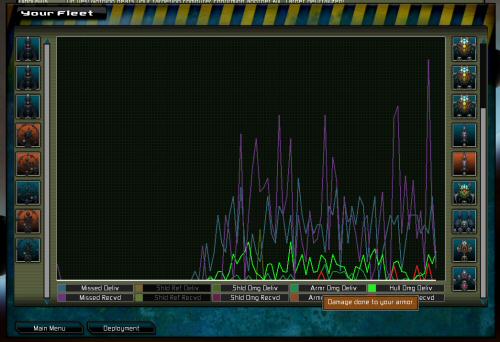
So an explanation of whats going on:

The graph shows  the damage done by every shot fired in the game, broken down into ten categories, which are missed, reflected by shields, damage to shields, damage to armor, hull damage, for both damage delivered (to the enemy) and received (from the enemy). The UI lets you toggle any of those categories on or off with a mouse click. Added to this, there are ship-pickers in two columns, with your fleet on the left, and the enemy on the right. By default all are enabled, but you can toggle each ship/squadron on or off. If you toggle them off, they get eliminated from the graph, which also auto-scales the Y axis to show things in better detail.

So if you want to know what effect your fighters have, you toggle off all the ships on the left except your fighters. if you then want to know what effect they had against enemy cruisers, you toggle off all the enemy ships except the cruisers. You can analyze it down to single pairings of ships if you like.

I’ve just realised I totally missed out damage ‘reflected’ by armor. I must add two new categories… bit of a squeeze now.

This isn’t the final screen, there is lots of minor UI tweaking to do, and it will have a more relevant title, plus I’d like to add options to view pie charts and other bits and pieces. Ideally I’d add little tags you could mouseover for events such as cruisers being destroyed, to put the charts in context. What I’m after is first impressions and feedback. Do you think that this is already an improvement on the old screen? I do, but I’ve spent 2 days on it so I’m biased :D .

My current plan is for this to just be in a patch, no add-ons needed. I am planning on a third new race expansion for the game at some point, because they seem popular and I love seeing new spaceships in the game :D .

Stats junkie?

Filed under: game design cliffski 4:09 pm March 21, 2010

Are you a stats junkie? I reckon that many gamers are, and given how popular games like Fantasy Football can be, I assume that there is a lot of scope for stats-junkie games. One of my original visions for Gratuitous Space Battles was WAY more stats-junkie than it currently is. I kind of let the side down a bit when I did the post-battle stats screen. If I could justify it, I’d like to work on that some more.

In my minds eye, the post-battle screen is like google analytics, but for space battles. You would be able to view the data in all sorts of different ways. A pie chart of which ships dealt the most damage? A bar chart showing the damage done by each weapon type. A line graph showing total damage inflicted over time, and showing hit points remaining on each side over time…

I’d find that pretty cool :D .

The only slight niggle in my mind is that if you make that stuff *too* good, then the people who will mico-manage and analyze every last weapons turret will have an even bigger advantage over the more casual player who just slaps on a few laser turrets and enjoys the show. In a sense, I don’t care about that, because the game is designed to be predominantly a single player game and sandbox, rather than highly competitive. Also, I’d imagine that all data is vastly open to interpretation, otherwise my obsessive poring over google analytics stats would have made me a dotcom billionaire by now. Still, if it takes being like this or this to be rich, I’ll stay poor.

Anyway, stats junkies? are you out there?

Venturing further into online bits

Filed under: game design,gratuitous space battles,programming cliffski 9:57 pm March 19, 2010

Today I didn’t write a single line of  C++, but did code a lot of php, which is the language I use for the online challenge management stuff in Gratuitous Space Battles.

On thursday I spent a lot of time blasting out the music from Star Trek : First Contact while I scrubbed out my chalk board and drew my vast plans for the future of GSB, or at least, the next DLC/expansion thing. After a lot of hand waving, I’m currently planning on a cunning meta-game style campaign that slots into some of the existing challenge data. It’s going to work a bit like spore, in that it becomes ‘massively singleplayer’, with other peoples content (in this case fleets) appearing in your game.

So far, so easy. That’s not a problem. The tricky bit turns out to be that although I let people mod the game (and that will continue), I can’t have a modded fleet turn up in someone elses game, because at worst, it could crash thinking “cannot find ‘bobsZapGun’ module…”

The solution, (which doesnt check for data changes as such, but does check for simple additions), is to write code which verifies that a players fleet only uses content that exists in the main game. To do that, php code was needed to crack open the binary challenge data and go through each ship hull and module name and check they really exist…

and to get THAT to work, I needed php code that would analyse all the data in the game and create a database of all the ‘valid’ entries, so that it can compare one with the other. That way if I do some module changes or new add-ons, I can just run some php and have the ‘valid data’ table automatically updated.

This is a lot of work in order to just get something totally under the hood and invisible working, which is code to ensure no modded content ends up in any one elses campaign, causing a crash. There is a ton of other work required. The good news is that a lot of this same code might be possibly leveraged at a later date to scan the high scores for modded content (and reject it) and could even remove the need to tag challenges with the add on packs manually as players do now. All fun and games….

In other news I just did a BLIND taste challenge and I *can* tell the difference between cadburys and morrisons chocolate buttons. (Cadburys taste smoother).

Humour?

Filed under: game design cliffski 10:49 pm March 17, 2010

I had no power for a while today (electrician doing much needed work on the 18th century museum we call a fuse box). As a result, I ended up trying to work with just a laptop on batteries and no web access. That meant time spent coming up with damage descriptions for modules as part of the campaign game.

I have decided to try and make them slightly silly sounding, a bit like the module descriptions or comms chatter. I have words that amuse me, by making me think of the Star Destroyers from Star Wars, but designed by wallace from Wallace and gromit. It’s not a huge leap. I can imagine wallace asking chewie to hand him the ‘hydrospanners’.

So the damage descriptions often mention the ‘primary flux sprockets’ or the ‘fusion inhibitor flaps’, and other things that blend trek-like technobabble with wallace and gromit style silly-tech.

I am aware that a lot of reviews quite like what I guess must be my sense of humour. I am not sure what the majority of actual gamers think. I have a sneaking suspicion that a lot of GSB players are 14-18 year old boys who love space battles, and thats awesome, I was that boy. I have a cupboard full of action figures to prove it. I took star wars pretty seriously. It was totally the most awesome film ever and ewoks were not teddy bears and leias hair was just FINE and not at all silly.

To my mind, the best example OF ALL TIME of perfection in the balancing act of being funny to 30+ adults and cool and exciting to under 16 kids was the original Batman TV series. Watch it as an adult and its a hilarious parody of how kids view crime fighting. Watch it as a kid and Batman ROCKS and is AWESOME.

Holy Scriptwriting!

Campaign Repairs

Filed under: game design,gratuitous space battles cliffski 9:15 pm March 15, 2010

I’ve been working on the future expansion/extra/dlc thing for GSB which will introduce mini campaigns, and have a slight design dilemma.

One of the main new elements of the campaign is that between battles, you can carry out drydock repairs to your surviving ships. So if a ship loses a beam laser entirely, you can entirely repair it for the next battle. Lost ships are lost, but ships at 1% can be repaired entirely, IF you have the cash/honor to do it.

So far, so good, I’ve been working on the UI for all this. However, it interferes with the way repair modules work. The idea of drydock is that you resupply everything, so repair modules are getting re-filled, and shields go back to maximum strength (assuming the shield modules survive).

The problem is, what happens to modules that were damaged slightly during battle, and the repair modules were fixing? If I let the battle run until the repair module runs out of supplies, any surviving ships will repair all of their vaguely intact modules. I can’t have a penalty for players who don’t want to sit and watch a progress bar rise after they won…

So that means that effectively, having a single repair module on a ship means all partial module damage is undone at the end of the battle, thus making repair modules more valuable than they currently are. This also gives the tribe a slight advantage, as they have frigate repair modules, and better ones anyway.

Possible solutions:

1) Deal with it. Repair modules are now more of a tactical option. Thats cool. The tribe have a bit of an advantage there, but that’s life.

2) Add supply limits to the campaign meaning supply modules aren’t available. This nerfs the tribe a bit.

3) Add some complex system, where in-battle repairs are jury-rigged temps that need to be re-done anyway at the drydock. This actually restores repair modules to be the ‘in-battle’ bonus they already are. However, they will then start doing those repairs of any un-repaired modules at the start of the next battle, which would seem very weird.

4) Add new code that automatically repairs all half-damaged modules anyway, regardless of repair modules. The lasting effect of battles is now just those modules that got totally destroyed, or ships that went bang.

Luckily I have a huge list of stuff to worry about before I need to make my mind up on this one :D

More != Better

Filed under: business,game design cliffski 6:00 pm March 14, 2010

I’ve been reading about the next star wars MMO.  This may turn out to be really good, but they way its being marketed at this stage scares me a bit. A huge chunk of PC Gamers interview with the developers is filkled with them listing how BIG the game is.

“its one of the most ambitious voiceover projects in the history of the videogame industry”

“by the time it’s done it will have more voiceover than the sum of all Biowares 17 other games”

“I’m suprised at the enormity of it”  (ooh-err)

etc.

It’s  not at all clear to me that ‘more content’ neccesarily makes for a ‘better’ game. I’m not even convinced it makes them more immersive. Aliens vs Predator (the original) was VERY immersive. By todays standards it would be very light on content. Maybe 1% of the impressive voice acting budgets of today. And those low res textures and low-poly meshes! eeek, how did we ever manage to be immersed!

Of all the ways to spend money and effort to make better games, voice acting has to be the lowest return on investment. I bet Patrick stewart got millions for Oblivion, yet his part in the game was memorable only for him sounding bored.

Big huge companies often throw a huge amount of money at projects and think that makes them better. Microsoft did it with vista (nice job guys!), and governments do it all the time, with hilariously poor results. The real hard, depressing, bitter fact is that more money doesn’t solve many problems. If the only way you can get people excited about what you are making is by telling them how much it cost, it’s a sad state of affairs.

Todays newspaper has an article on the new WW2 TV series with Tom Hanks in, From the cover-article highlight, I can currently tell two things about it. It has Tom Hanks in, and its THE MOST EXPENSIVE TV SERIES EVER!!!

That is apparently it’s unique selling point. I hope thats just crap marketing, and the series is good…

Jam tomorrow

Filed under: business cliffski 6:20 pm March 12, 2010

The rumour is that a lot of people are staying on at Infinity Ward because they are owed huge bonuses from COD:MW 2 and if they quit before they are paid, they lose the right to them.

This is depressing, and very evil, and not at all uncommon. Not just in games, but everywhere. I’ve had a lot of different jobs, in a lot of different companies, and the vast, vast majority of them have an employee incentive scheme called ‘jam tomorrow‘. They don’t call it that, but that’s what people call it when they see it for what it is.

There are basically two strategies to keeping decent staff. (Nobody cares about keeping bad staff, in fact, they are doing you a favor if they quit). They are:

1) Make the job great, in terms of earnings, benefits, working environment and job satisfaction

2) Vastly increase the opportunity cost of quitting.

Now clearly 1) costs a lot more than 2). You can pay the gullible fools a pittance, not pay out any benefits, and make their lives miserable, and the dumb schmucks still stay in their cubicles. Clearly 2) is the way to win!

But that is old school thinking from factory floors, the industrial revolution, people churning out simple, measurable, mechanical work, where the objective was just to keep people working.

Game development doesn’t work like that. The work is very difficult to measure. You can’t stand over a programmer and tell if he is working well, or hard, or at top efficiency. Ditto an artist.  Is that texture the best you can do? Really? How do I tell?

Activision are using the sort of trick that cynical factory owners used to try and keep people working the lathe, and that just plain does not work for knowledge workers. I did my best work when I was motivated and happy, and my worst work when I was cynical, negative and felt cheated. I’d wager you are the same. It’s a worse strategy than just flinging monkey shit at your staff, because at least then, they would quit and you would realise you are doomed. This way, the staff stay there and grumble and drag the productivity of the company down.

Activisions strategy might look to them like it is working. But it isn’t. They are just demotivating their staff and delaying the inevitable resignations. This isn’t a 19th century pin factory, it’s 2010 and the new economy. Someone tell the activision bosses that.

Next Page »